Enjoy free U.S. shipping on orders of $150 or more after discounts.
More Is More
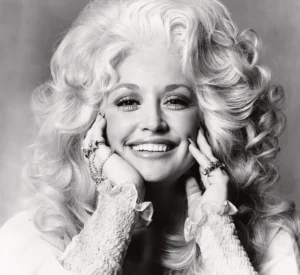
Dolly Parton spent decades making a visual argument that fashion does not have to be restrained to be intelligent.
Her hair was bigger than necessary. Her heels were higher than practical. Rhinestones appeared where a quieter dresser might have stopped three decisions earlier. She understood the joke, participated in it, and then made it impossible to imagine her any other way.
Following Parton’s death on August 25, much of the conversation has understandably centered on the songs, the generosity, the business acumen, and the warmth that made her feel unusually close to people who never met her. But fashion was not a side note to that legacy. It was one of the languages she used most fluently.
Parton was not simply “glamorous.” Plenty of people are glamorous. She built a complete visual identity and maintained it long enough for the world to understand it. That is a much more interesting achievement—and a useful lesson for anyone trying to develop personal style in an era built around constant reinvention.
Photographed by Irving Penn, Vogue, October 1977
“I remember feeling really pretty.” WireImage
Parton did not dress to disappear into the idea of good taste. She dressed to be recognized.
That distinction matters. Approval asks whether the outfit satisfies an outside standard: sophisticated enough, expensive enough, current enough, flattering enough, quiet enough.
Recognition asks whether the clothes make sense as an extension of the person wearing them. Parton’s answer was immediate.
Blonde wigs, saturated color, close silhouettes, sequins, fringe, high heels, exaggerated femininity: the components changed across decades, but the grammar stayed remarkably stable. Her longtime stylist and creative director Steve Summers has described her as someone who did not follow trends. She developed a visual language strong enough that trends had to pass through Dolly rather than the other way around.
That is what most personal-style advice misses. You do not become recognizable by buying more different things. You become recognizable by noticing what you continue to choose.
Parton and Stallone dressed to the nines for the “Rhinestone” premiere in New York. Ron Galella / Getty Images
Parton knew exactly how her appearance could be read. She joked about overdoing it and famously played with the idea that her look was expensive artifice masquerading as something cheap. The humor protected her from a cultural habit that often mistakes understatement for intelligence and excess for unseriousness. But there was real design discipline underneath the joke.
Exaggeration works when the exaggerations belong to the same world. Big hair, a highly defined waist, sparkle, manicured hands, a heel, a stage silhouette: each part strengthened the others. Remove the coherence and the look becomes random. Keep the coherence and “too much” becomes authorship.
This is why camp can be sophisticated. It does not require the wearer to believe the fantasy literally. It requires them to understand the fantasy well enough to control it.
Fashion rewards novelty. Personal style often rewards repetition.
An image becomes iconic because we can recognize it before we have processed every detail. Think of a severe black turtleneck, a certain red lip, a narrow trouser, a towering wig. Repetition builds visual memory.
Parton’s consistency never meant wearing the same outfit forever. She used a stable vocabulary across country performance costumes, red carpets, film roles, business appearances, holiday specials, and everyday publicity. The degree of sparkle could change. The silhouette could shift. The woman remained legible.
That is useful for ordinary wardrobes too. If you repeatedly love an exaggerated shoulder, a tiny evening bag in daytime, silver jewelry, fitted knitwear, western boots, or a romantic blouse with something hard underneath it, that repetition is not evidence that you need more range. It may be evidence that you found your language.
She wore one of her signature, form-fitting glittery jackets at the 2005 CMAs. Scott Gries / Getty Images
Part of Parton’s power was that she never needed everyone else to maintain the fantasy for her.
She could call herself an eyesore and still show up covered in rhinestones. She could discuss the construction of the image without making the image less effective. She could be deeply sincere and completely in on the joke at the same time.
That combination is rare in fashion, which can become painfully earnest about itself. Clothes are meaningful, but they are also funny. Bodies are strange.
Trends are arbitrary. A shoe can change your posture and still be an objectively ridiculous object. Personal style gets better when you can care about clothing without needing clothing to prove that you are serious.
The person who can laugh at an outfit and still wear it has more freedom than the person terrified of getting it wrong.
Kevin Mazur / Getty Images
One of the laziest ideas about authenticity is that the most authentic version of a person must also be the least constructed.
Parton’s image dismantled that idea. Wigs, makeup, costumes, nails, padding, tailoring, sparkle—construction was not evidence that the persona was fake. Construction was how the persona communicated.
Fashion has always involved artifice. A corset changes the body. A shoulder pad changes the body. A suit changes the body. Denim carries its own cultural mythology. Minimalism is as constructed a visual code as rhinestones are; it simply hides its decisions more successfully.
Authenticity in dress is not the absence of artifice. It is the ability to choose the artifice that feels like yours.
Finding your personal style is about understanding the relationships between the pieces in your wardrobe.
Whether vintage or modern, knowing how to tell if clothing is good quality can transform your style.
Quirk BOUTIQUE, is located at 112 West 9th St. #200 Los Angeles, CA 90015
No matching labels. Try another name.