Enjoy free U.S. shipping on orders of $150 or more after discounts.
The Art of Getting Dressed
There is a particular kind of pleasure in finding a label that makes you stop before the price tag does.
Not because the name is currently loud, but because the garment contains information: an unusual closure, a sleeve cut with conviction, a textile that does not resemble anything in the next twenty feet of rack, or a construction detail that suggests somebody behind the label had an actual theory about clothes.
Many of the designers below are represented in major museum collections. Some changed American sportswear, streetwear, knitwear, or evening dress. Yet their labels can still be passed over by shoppers trained to recognize only the same small group of luxury names.
This is not a definitive list, and it is not a guarantee that every piece is valuable. It is the beginning of a visual education. These are names that make us look twice.
Willi Smith’s idea of ‘street couture’ feels strikingly current because it refused the hierarchy between experimental culture and accessible clothing.
WilliWear offered adaptable separates with movement, ease, and downtown energy. The work connected fashion with artists, performers, filmmakers, and the street without turning that relationship into costume. Cooper Hewitt’s major exhibition on Smith describes the way he crossed social, cultural, and economic boundaries through affordable, adaptable design and collaboration.
On the rack, look for relaxed shirts, fluid trousers, oversized coats, inventive prints, workwear references, and pieces that can be rearranged rather than worn one correct way. Earlier labels and unusual artist-related pieces deserve research, but even simpler WilliWear can carry the ease that made the project radical.
Why we stop: democratic design with real cultural intelligence.
Bonnie Cashin helped define a version of American sportswear that was practical without becoming visually anonymous.
Her work is recognizable through layered shapes, generous pockets, leather trim, metal toggles, strong color, and the use of luxurious materials in clothes meant for active life. She also worked with Coach, which helps explain why her approach to hardware and utility feels so complete.
Look for Bonnie Cashin labels, Sills, Cashin Country, distinctive toggles, bound edges, ponchos, shaped knits, leather-trimmed coats, and pieces where the pocket is part of the architecture rather than a concession. Condition matters, especially with leather and hardware, but a strong Cashin design can look astonishingly modern.
Why we stop: function treated as visual pleasure.
Koos van den Akker made collage wearable.
His patchwork garments combine color, pattern, texture, and fabric in ways that can look chaotic until the body gives them rhythm. The strongest pieces are not merely busy. They have composition. A stripe redirects the eye, a velvet panel gives weight, a floral interrupts geometry, and the silhouette holds the whole argument together.
The Met holds multiple examples of his ensembles, coats, dresses, and capes. On a resale rack, check the construction closely because the complexity of the textiles is part of the value. Look for intentional patchwork, strong color relationships, interesting backs, and labels that match the likely era.
Why we stop: maximalism with a brain.
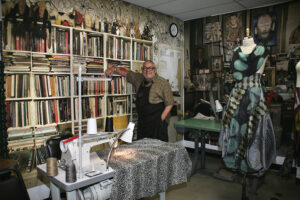
Koos van den Akker in his classroom at the School of Fashion. Photo by Bob Toy.
Stephen Burrows understood color and movement at the level of the body.
His work is closely associated with fluid jersey, color blocking, contrast stitching, and the lettuce-edge finish that turns a seam into a line of motion. The clothes can appear deceptively simple on a hanger. On a body, the cut and edge treatment create energy.
Look for Stephen Burrows labels, bright jersey, narrow dresses, asymmetric color, visible seam treatments, and pieces that move rather than stand. Examine older jersey for thinning, stretching, and repairs. When the fabric remains healthy, the clothes can feel immediate rather than archival.
Why we stop: the garment changes when the wearer moves.
https://www.wmagazine.com/fashion/designer-stephen-burrows-life-in-parties
Mary McFadden’s pleated columns are easy to recognize once you have seen the real thing.
Her ‘marii’ pleated fabric created a distinctive liquid, permanent texture, often used in shapes informed by ancient dress, global textiles, and ceremonial ornament. The Met describes her approach as anthropological, with garments that reference the kimono, chiton, and sculptural drapery without constricting the body.
Look for fine, regular pleating, column shapes, rich color, metallic or embroidered borders, and the Mary McFadden label. Not every pleated dress is McFadden, and not every McFadden piece is equally desirable. Condition is crucial because crushed or distorted pleats can be difficult to restore.
Why we stop: eveningwear that behaves like portable architecture.
https://wwd.com/fashion-news/designer-luxury/mary-mcfadden-designer-dead-1236614738/
The Met notes that in 1957 he became the first Black American to lead a Seventh Avenue design studio, Bobbie Brooks, and places him within a generation of designers who expanded racial diversity in New York fashion through the following decades.
His work can range from polished daywear to evening pieces with strong color and surface. Look for Arthur McGee labels, precise tailoring, bold but controlled palettes, and garments that balance sophistication with real wearability. Because the name is less familiar to the broad resale audience, research is essential and opportunities still appear.
Why we stop: American design history that should not be treated as a footnote.
Finding your personal style is about understanding the relationships between the pieces in your wardrobe.
https://wwd.com/fashion-news/fashion-scoops/arthur-mcgee-designs-auctioned-in-march-1235487467/
Claire McCardell’s work helped establish the intelligence of American ready-to-wear.
She designed functional, affordable clothes in materials such as cotton, denim, and wool, often using adaptable shapes, practical fastenings, pockets, ties, and forms that allowed the wearer to participate in the styling. The clothes can look simple because their innovation became part of the language everyone else used later.
Look for Claire McCardell labels, Townley Frocks, wrap and tie constructions, metal hooks, pockets, playsuits, wool jersey, and garments that transform with the body. True McCardell pieces require careful authentication and are not common, but the label is worth recognizing immediately.
Why we stop: modern American dressing before ‘modern’ became a marketing word.
Labels changed across time. Designers worked through manufacturers, department stores, diffusion lines, licenses, and collaborations. Counterfeits exist, misattributions happen, and marketplace descriptions repeat one another until speculation begins to look like fact.
Read the label, then read the garment. Compare typography, construction, country of origin, fiber labels, closures, and silhouette with documented examples. Search museum collections and reputable archives before relying on an anonymous listing. Ask whether the piece expresses the design language associated with the name.
Fashion history becomes more useful when it changes how you shop. The reward is not only finding something potentially valuable. It is seeing more clearly. A crowded rack becomes an archive, and a label most people ignore can open an entire world.
Whether vintage or modern, knowing how to tell if clothing is good quality can transform your style.
Quirk BOUTIQUE, is located at 112 West 9th St. #200 Los Angeles, CA 90015
No matching labels. Try another name.